


Written by Clinical Psychologist, Katie Dobinson
Have you ever delayed starting a task because you wanted to get it exactly right? Or found yourself rewriting an email too many times, overthinking a decision unnecessarily, or putting something off because you were scared you might fail?
Perfectionism can sometimes motivate us to set high standards and work hard to achieve them. But when those standards are rigid or unrealistic, they can leave us feeling inadequate and stuck. Instead of helping us move forward, perfectionism can lead to self criticism, procrastination, and what is often called perfectionist paralysis: an immobilising fear that keeps us from starting or finishing tasks because of the desire to get everything perfect.
The good news is that loosening the grip of perfectionism is possible. You can learn to become more flexible in how you think, behave and approach challenges.
Today we’ll explore how flexible thinking, which is an important skill taught in Cognitive Behavioural Therapy (CBT), can help reduce perfectionism.
What is perfectionism?
Funnily enough, there is no ‘perfect’ definition for perfectionism, and one person’s experience of perfectionism can differ from another’s. However, perfectionism can be understood as the process whereby a person strives towards excessively high standards, often leading to low self-worth and fear of negative evaluation when these standards aren’t met. A person can keep pursuing perfectionism, even when it comes at a cost.
Perfectionism can show up in different parts of life: work, study, home, family and relationships, health and fitness, personal appearance, even hobbies and interests.
It’s important that we work towards goals and put in our best effort. However, when we consistently put pressure on ourselves to perform without making a mistake, base our sense of self-worth primarily upon achievement and outcome, or when perfectionism has negative effects on our life, this can become problematic.
Perfectionistic thoughts might sound like:
- “I must get this completely right every time”
- “There’s only one correct way to do this or else”
- “If I make a mistake, I’ve failed”
- “If I can’t do it perfectly, there’s no point trying”
- “Others will think badly of me if it’s not 100%”
Over time, these rules can become so strict that they make it difficult to begin, continue or finish tasks due to the unattainable standards that are set. Common perfectionistic behaviours include excessive checking, reassurance seeking, planning, researching, or organising, difficulties with delegating to others, inefficiency, indecisiveness, quitting prematurely and avoiding tasks.

The perfectionism-procrastination link
Perfectionists are often believed to be people who usually never make mistakes, achieve highly in many areas of their chosen pursuits, and are highly motivated to ‘get the job done’. However, did you know that perfectionistic tendencies are often linked to procrastination?
Procrastination is when we put off or delay doing something that we need to get done. Many people get caught in the vicious cycle of procrastination due to unhelpful perfectionistic thoughts and behaviours.
For example, if you have extremely high standards for an assignment that is due, you may procrastinate getting started because of perfectionistic beliefs such as “I have to get it right from the start”, “My work is never good enough”, or “I need to start the task when I’m feeling completely relaxed, without any anxiety”.
These thoughts are not due to laziness, rather, due to ‘perfectionist paralysis’ where we avoid approaching a task due to fear of making an error. This is unhelpful, as we keep putting it off. In the end, it makes it harder to approach the task and our perfectionism and procrastination behaviours feed into one another, leading to more pressure and stress.
Bonus! Check out our handy resource that gives you some further insight into procrastination and some of the helpful ways to address it.
Why flexibility matters
The “rules” that are set by perfectionistic thinking tend to be rigid. It tells us there is only one right answer, one perfect outcome or one acceptable way to do things.
Flexible thinking offers another perspective.
Instead of all-or-nothing thinking, flexible thinking allows us to recognise shades of grey. It helps us adapt when things don’t go to plan, consider alternative perspectives and continue moving forward with achieving our goals and tasks.
Flexible thinking can sound like:
- “I’d like to do this well, but it doesn’t need to be absolutely perfect”
- “Mistakes are part of learning and growth”
- “I can give myself permission to be imperfect, just like anyone else”
- “There may be more than one way to approach this”
- “It’s possible that good enough really is good enough”
Flexibility is more realistic, compassionate and allows yourself more room to learn, adapt and grow.
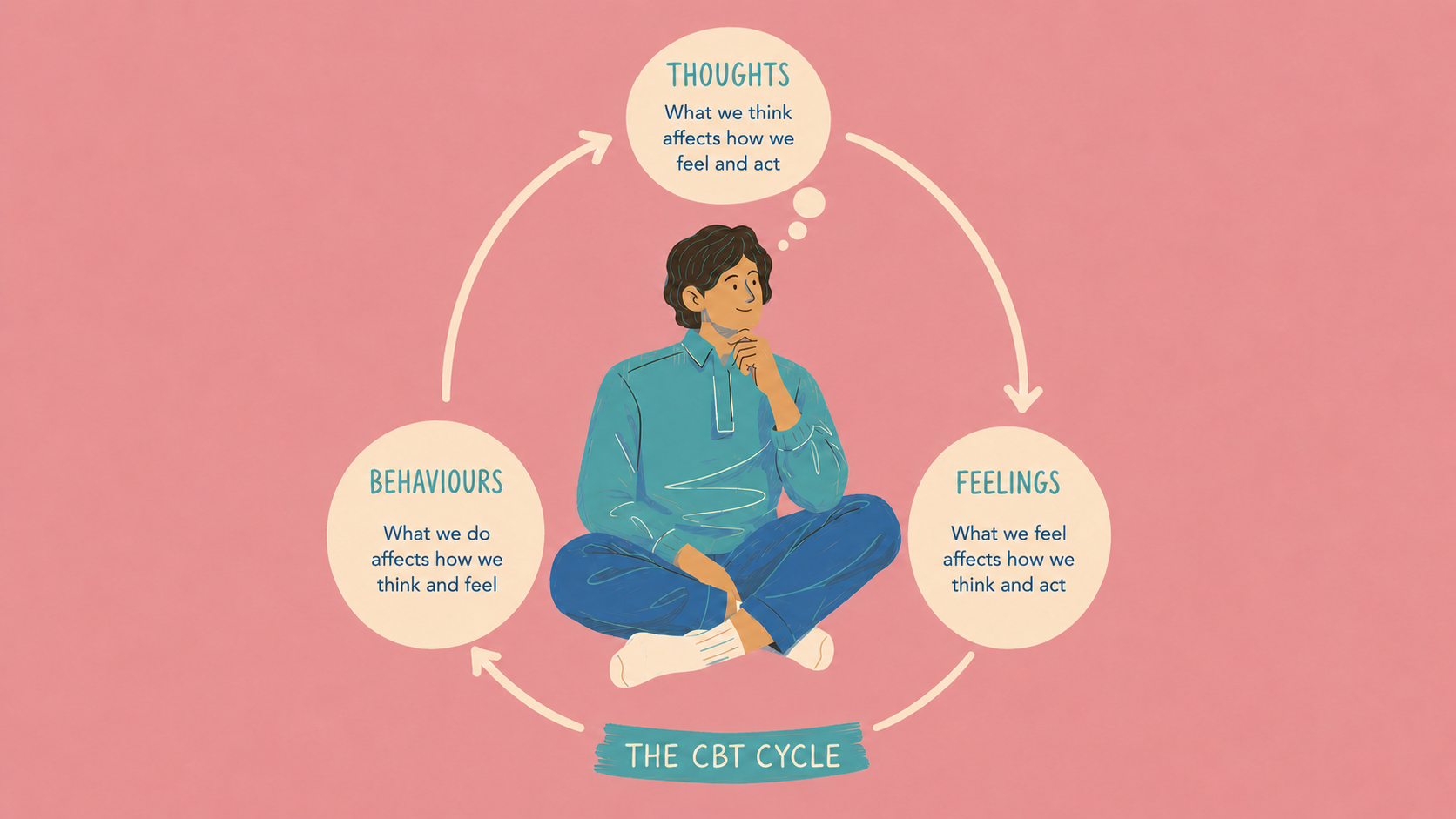
How CBT can help
Cognitive Behavioural Therapy (CBT) helps us understand the relationship between our thoughts, behaviours and physical sensations, in affecting how we feel.
When it comes to perfectionism, CBT can help:
- identify rigid or unhelpful thinking patterns
- challenge unrealistic or unattainable standards
- develop more balanced, healthy ways of thinking
- reduce avoidance and procrastination
- practise behaviours that build confidence and flexibility
Recent research has found that internet-delivered CBT – specifically THIS WAY UP's Generalised Anxiety program - can reduce perfectionism alongside improvements in anxiety, depression and psychological distress.

Five ways to practice flexible thinking
1. Look for the middle ground
Perfectionism often makes us see things in extremes: success or failure, perfect or terrible, productive or lazy.
Ask yourself: Is there a more balanced way to look at this situation?
Perhaps your work isn’t flawless, but it may still be helpful, meaningful or good enough.
2. Swap “must” for “could”
Words like must, should and have to can create undue pressure and make mistakes feel unacceptable.
Try replacing them with: could, would like to or prefer to.
- For example:
“I must do this perfectly” becomes: “I’d like to do this as well as I can.”
3. Treat tasks as learning opportunities
Perfectionism can make every task feel like a test of our abilities.
Instead of asking: “Can I do this perfectly?” try asking: “What can I learn if I give this a go?”
Approaching challenges with a growth mindset, rather than a performance mindset, can reduce pressure and increase motivation..
4. Aim for progress, not perfection
Sometimes “good enough” really is enough.
You might ask yourself:
- What is the smallest next step?
- What would “good enough” look like here?
- What would I say to a friend in this situation?
- What will it cost me to strive for excessively high standards and is it worth it?
5. Make room for mistakes
Mistakes can feel especially uncomfortable for perfectionists. But avoiding mistakes altogether can also mean avoiding opportunities, experiences and growth.
Flexible thinking allows us to view setbacks as information to reflect on rather than evidence of failure.
A mistake doesn’t necessarily mean you’ve failed. It may simply mean you’re learning, adapting or trying something new. It may also simply mean you’re human, like the rest of us. Practice extending compassion to yourself.

Moving from perfection to flexibility
Perfectionism tells us there is only one right way forward. Flexible thinking reminds us that there could be many.
By noticing rigid rules, allowing room for mistakes and focusing on progress rather than perfection, it becomes easier to take action. You can learn to approach yourself, your goals and your challenges with greater flexibility.
Sometimes, the goal isn’t to do something perfectly. It’s simply to take the next step.
The perfectionism-anxiety link
Many people with perfectionism often have difficulties with excessive worry. If you would like to learn practical strategies for managing persistent and hard-to-control worry that feeds into your perfectionism, take a look at our clinically-proven online treatment program for Generalised Anxiety.
You can register here right away and start feeling better today.